posted June 19,
2009
To follow is the feature article in the current
issue of BluesWax. The entire issue is
devoted to the life and music of Koko Taylor
and includes remembrances of her from B.B. King,
Bonnie Raitt, and a host of others. It also
contains Alligator Records President Bruce
Iglauer's moving comments from the funeral
service held in Chicago last Friday.
Information about how you can register to
receive your copy of BluesWax free is included
at the end of the article.
Pickin' The
Chicken When The Water Is Hot
A Queen Who Never Rested On Her Crown
By Don Wilcock
Koko Taylor
December 28, 1928 to June 3, 2009
Photo by Jef Jaisun
What an
exit! Koko Taylor's funeral took place on
Friday, June 12, the first night of the Chicago
Blues Festival. Who could be more deserving of
becoming the centerpiece of the largest Blues
festival in the world in the city she called
home for 56 years. The Queen of the Blues
brought a woman's heart and love to a man's
game. If there was a glass ceiling for female
Blues singers, she broke through it with a style
that was every bit as raw and real as her male
mentors who electrified the Delta Blues sound.
Howlin'
Wolf first recorded "Wang Dang Doodle," but
it was Koko Taylor who made it a hit in 1966.
With her upper body extending forward at a
thirty-degree angle, her fist clutching the
microphone, and her jaw opened wide, she turned
writer Willie Dixon's vision of a
Saturday-night union hall Blues jam on its ear.
It was one thing for a male monolith from the
Delta like Howlin' Wolf to sing about people who
"romp and tromp till midnight" and
"fuss and fight till daylight," but Koko was
a lady in every sense of the word. In fact, when
Willie Dixon first asked her to record the song
that would earn her the label Queen of the
Blues, she wasn't at all sure she could buy into
the song.
"I didn't
like it at the time," she told me in 1990,
"because it had all them weird names in there.
To me, it was like talkin' about people. You
know, pinpointing people like
'Butcher-Knife-toting Annie,' 'Fast-talking
Fannie,' and all that stuff. I said, 'Where did
you come up with all these people from? Why do
you want me to sing a song like that? I don't
wanna do that one. I'd rather do another one.'
He said, 'Koko, this is a good song. If you do
this tune, the people gonna like it.'"
Koko was
rubbing shoulders with Chicago's top Blues
artists and she felt she was in the middle of a
Cinderella story. "It was like a dream. It never
happened. But this did happen, and [Willie
Dixon] told me he was an A&R man for this
company, Chess Recording Company, and he would
like to have me down for an interview with
Leonard Chess and see what they thought
about it because he was sure they would agree
with him that I had the greatest voice in the
world for Blues singing."
Still,
Koko just didn't like "Wang Dang Doodle," and
she didn't like how Willie Dixon was working
her. She told me in 1998, "[I gave Willie Dixon]
a lot of trouble [when he called and asked me to
work on "Wang Dang Doodle"]. First of all, it
was in the middle of the night [laughs]. It was
in the middle of the night, and I'm working at
that particular time. I'm doing what we call
domestic work up on Chicago's North Side, and I
had to go to work the next morning and to stay
up practically all night with him working on
this song? I thought it was ridiculous. I went
down there and we got to working on that, and he
says to me, 'Look, we got to pick the chicken
while the water's hot!'"
That
picked chicken was Chess Records' last Blues
hurrah. They were selling Rock and Soul with
acts like Rotary Connection and The
Dells, but "Wang Dang Doodle" was the last
Blues hit for a company built on the songs of
Koko's mentors Howlin' Wolf and Muddy Waters.
"Wang Dang Doodle" reputedly sold more than a
million copies for a label that was searching
for a new market among white Folk music fans in
1966. This was hardly "Folk music," at least not
the way it was defined in 1966. Recorded on
Pearl Harbor Day, December 7, 1965, the single
featured a who's who of the Chess session
musicians: Buddy Guy and Johnny
"Twist" Williams on guitars, Fred Below
on drums, Jack Meyers on bass, Gene
"Daddy G" Barge on sax and the Chess A&R
majordomo Willie Dixon himself on vocals with
Koko.
By 1969,
the independent Chess label was sold off, and
Koko was left with little more than a memory of
her one hit and two albums that sold poorly.
"Oh, no. I never got [my proper royalties from
Chess]," she said in 1981, almost laughing at
the absurdity of the mere suggestion. "I didn't
know what the word 'royalty' meant. With the bad
and the good, I just hung on in there. It wasn't
the receiving of a lot of money. That was the
thing with me, it was because I loved what I was
singing."
Forty-two
years after hitting the charts with "Wang Dang
Doodle," Koko Taylor had long since made peace
with that song's meaning to her career and her
moral and religious beliefs. "I know the
difference from Blues music and Gospel music,"
she told me in 2007. "So, I don't mix the two
together. They don't go together at all. That's
like mixing the devil with God, and you can't do
that. There's nothing wrong with singing "Wang
Dang Doodle." I don't find nothing wrong with it
at all, and I find the public enjoys what I'm
singing and everything. So, yeah, I enjoy
singing it."
A lot of
records and a lot of road miles marked Koko
Taylor's life after "Wang Dang Doodle." Bruce
Iglauer, head of the fledgling Alligator
Records, had seen on Koko when she regularly
guested with Mighty Joe Young at The Wise
Fools Club and signed her. "It's a much smaller
company," explained Koko. "It's what they do for
the artists. Alligator really gets the
recordings out there and tries to get them
promoted and get 'em where the people hear 'em
and buy 'em. A lot of recordings for Chess were
never released. A lot of people didn't know
about me other than 'Wang Dang Doodle' until I
got with Alligator."
The title
"Queen of the Blues" and one million-selling hit
did not mean that life suddenly became easy for
Koko. One of six children and an orphan at
eleven, she lived in a shotgun shack with no
running water or electricity and as a child
picked cotton on a sharecropper's farm outside
of Memphis. She and her husband-to-be Pops
Taylor had moved to Chicago in 1952 with 35
cents and a box of Ritz Crackers.
Willie
Dixon gave Koko her bachelor of arts in
Bluesology by teaching her how to write and
deliver a good blues song, but it was Bruce
Iglauer who handed her an honorary master's
degree in fine arts. She released her first
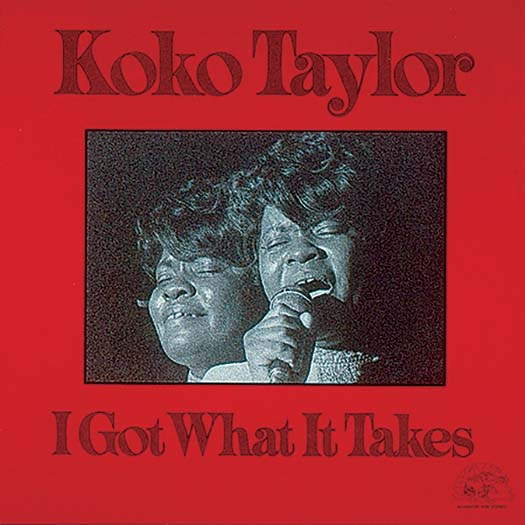
Alligator album, I Got What It Takes, in
1975. The title cut was a remake of the first
single she ever put out on Chess Records. While
that song and the majority of her Chess
recordings were written by Willie Dixon, many of
her Alligator LPs had three or four Koko
originals on them with titles like "Voodoo
Woman," "Can't Let Go," "Don't Let Me Catch You
with Your Drawers Down," and "Hard Pill to
Swallow."
"I had
never wrote a song before in my life, and when
he [Willie Dixon] told me about he wanted me to
write this song, I says to him, 'I don't know
nothin' 'bout writin' no songs.' So, he
demonstrated to me all I gotta do is think about
everyday, everyday surroundings. Just look over
my shoulders, and you'll see something to write
about. 'All I want you to do is whatever you say
in your song has got to make sense. It got to
tell a story, and it has to have a meaning.' He
learnt me that."
None of
her other Chess or Alligator recordings had the
commercial impact of "Wang Dang Doodle," which
she again recorded on The Earthshaker for
Alligator in 1978, but six of her nine Alligator
releases were nominated for a Grammy Award, even
though her one Grammy win was in 1985 for
Blues Explosion, a multi-artist release on
Atlantic Records. Each of these albums was
co-produced by Bruce Iglauer and, in addition to
her regular band, featured guests who included
Buddy Guy, B. B. King, Kenny Wayne Shepherd,
Bob Margolin, Keb' Mo', Pinetop Perkins, and
Lonnie Brooks.
She had
the title Queen of the Blues, but when I talked
to her in 1998, she had come to realize that
royalty, too, has its dues to pay. "It's nothin'
easy to ride up and down the highway like when I
came out where you at. Go from Chicago to New
York, and I sure ain't getting' rich, ya know?
And to pay all the dues and the struggles,
drivin', sleepin' on a bus. You get where you're
goin'. You've got a hotel from night after
night. You're in a different hotel bed away from
your family, your friends and again it ain't
like you getting' a whole bunch of money. So,
hey, you got to love what you doin'."
On the
road more than nine months a year, the law of
averages had caught up to her. In 1988, she
suffered an accident when the band's van driven
by her husband suffered an accident. He
eventually died, and the incident almost took
her out of the game. "Our van went off a
mountain cliff right out of Chattanooga,
Tennessee, called Swannee, and I ended up with
three broken ribs, broken shoulder, and collar
bone, and just banged up real good there. Thank
God I came out of it brand new again," she told
me in 1990, "and I'm just real thankful. I'm not
having no problems now at all, and that's good."
"It was
kinda rough, but I got my inspiration from just
knowing this is what I like to do, and after my
husband passed away, my music was the best thing
happening for me. Just get back out here and do
it, and it really helped me because it kept my
mind occupied. It kept me from thinking about a
lot of things I would have been thinking about,
worrying about on a lot of stress. It just eased
that a little."
Life's
next big hurdle came in 2003 when she was
operated on for gastrointestinal problems. "When
she became ill in 2003 and had her surgery, she
was on a ventilator," explained Iglauer. "She
was on life support. The doctors were telling us
not to have much hope, that it was not likely
that she was ever going to be conscious again,
much less be out of bed, much less singing or
recording and basically we were on sort of a
deathwatch, and Koko refused to die.
"She
willed herself back to life against all odds and
then willed herself back to singing, willed
herself back to the stage, willed herself back
to the recording studio. She had incredible
strength, strength that came from all those
years of living on personal and financial
adversity, coming up the hardest way you could."
Koko
seemed to gain new traction after her brush with
death. Her last album, Old School, in
2007 was one of her finest and featured two
Willie Dixon songs, "Young Fashioned Ways" and
"Don't Go No Further." I saw her that year in
Albany, New York, and she appeared frail,
relying on the support of her devoted daughter
Cookie, but four weeks before her passing in May
of this year, she won her 29th Blues Music Award
in Memphis and delivered a sparkling version of
"Wang Dang Doodle" backed by the Mannish Boys.
"I'm real
proud of myself and my fans," she told me in the
basement of Petrillo Band Shell in 2007 during
the Chicago Blues Festival. "It helped so much
just to be out with my fans. It helped me not to
be so depressed. It helped ease some of the
pressure that I had on my mind behind losing my
husband and things like that, but as far as
putting everything into it, I was doing that all
the time. I always did put all I had into a
song, into a recording. When I'm on a bandstand,
I put all I have into it, you know? So, it was
really nuthin' new. It was like a valve
released, a release valve."
Bessie
Smith called herself The Queen of the Blues
in the 1920s. Artists like Billie Holiday,
Big Mama Thornton, and Etta James
gave women a high profile in the genre before
Koko Taylor's arrival on the scene, but she
walked into the lion's den where others feared
to tread. She hung with the Chicago male
hierarchy Willie Dixon, Muddy Waters, and Howlin'
Wolf. And when those Blues icons were struggling
to keep an audience by rubbing shoulders with
the British Blues rockers, she showed them that
a woman could take their music back to its
unadulterated roots, selling more copies of one
single in 1966 than her mentors had even in
Chess's heyday of the early 1950s. Not only was
she a successful crossover taking the roots to
the new audience on the North Side and the
college crowd worldwide, but she did it with a
personal dignity, family values, and a
personality that said there was a place for
women in this game.
Surrounded
by Chicago survivors like Eddie Shaw and
Jimmy Dawkins at the Chicago Blues Fest in
2007, she told me, "I'm here to please all of
these people, and you can't please everybody,
but we try, and that's what I do is try to reach
out and please and make everybody feel good and
enjoy what I'm out there doing. People walk up
to me after I finish a show, a lot of people
walk up to me and say, 'This is the first time I
ever heard the Blues, but after listening to you
tonight, I am a Blues fan. I didn't know I would
enjoy it as much as I enjoyed you.' See, that
means a lot to me. That means I have did a song
that helps somebody. They go, 'Oh, that song you
did, "I'd Rather Go Blind," it just made my
day.' Well, they just made my day!
"The
bottom line is I'm still hanging in there,
looking forward, getting through with my CD, and
looking forward to movin' on up, keep movin' on
up till I reach the sky, and if I land in the
cloud, I'm still happy."
Don
Wilcock is the editor of BluesWax. He has
also written the authorized biography of Buddy
Guy and was the recipient of the Keeping The
Blues Alive Award for Journalism from The Blues
Foundation last year. Don may be contacted at
blueswax@visnat.com.
g
Originally published in BluesWax (www.blueswax.com).
Reprinted here with permission. BluesWax is a free
weekly publication covering the Blues. It is
delivered via email each week only to subscribers.
They never share reader information or send anything
else. Just the Blues! Subscribe at
www.blueswax.com.